
Published on
15 October 2026
Access is not special treatment: Stephanie's story
"You can be sitting in the room and still be excluded from what is happening around you."
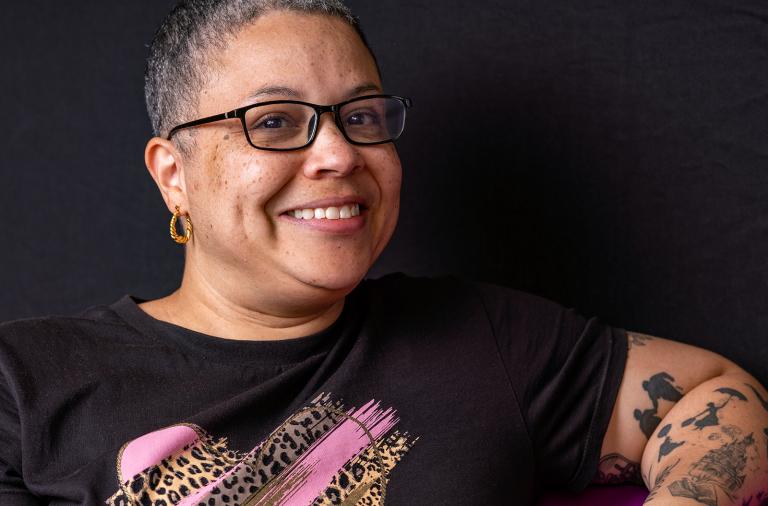
Social Care Future is about people living the life they want to live, with the people and things that matter to them, in communities where we look out for one another. But people can't truly belong if they can't access the places, services and opportunities around them.
For Stephanie, belonging means more than being invited into a room. It means being able to take part properly, having communication access and knowing she can be herself.
Stephanie is a Black Deaf woman of Bermudian heritage, a mum of three boys and the person behind WovenAware.
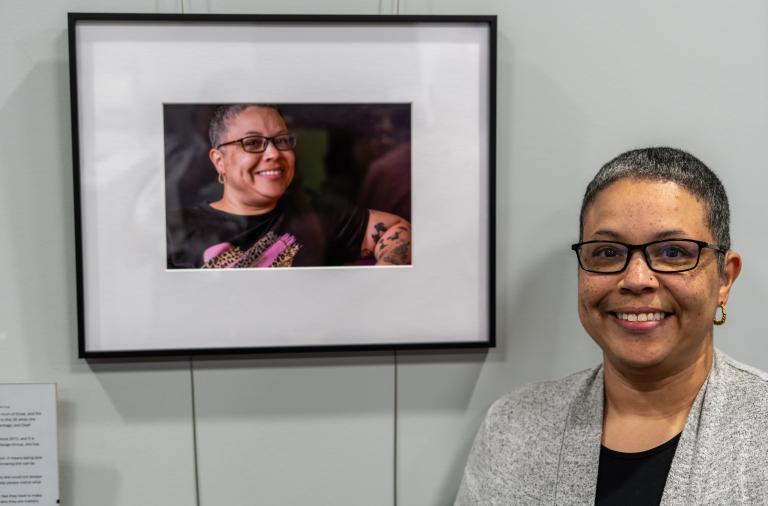
Born in Bermuda, she moved to the UK when she was five for better access to Deaf education. Wokingham has been home for her and her family since 2012. This October, she is one of the people featured in the Black History Month exhibition at Wokingham Library.
Seeing the threads
WovenAware grew from years of experiences Stephanie couldn't always put into words. Through WovenAware, she explores what sits beneath the surface.
"Something can happen years ago and at the time you think it was just one experience," she said. "Then later you begin connecting it to other experiences and realise there are wider threads around communication, access, identity, belonging, power or the way systems work."
Being a mum to two hearing sons and one Deaf son has shaped that perspective too.
"Even within one family, children can experience communication, access and belonging very differently," she said. "If something I write helps somebody recognise a pattern in their own experience, put words to something they have struggled to explain or simply look at something differently, that matters to me."
As she puts it, the heart of WovenAware is simple: "Wake up. See the threads."
From being present to being included
One of the threads running through Stephanie's life is access, and the difference it makes when it's there.
"When access is there, I can concentrate on the conversation rather than constantly trying to work out what I have missed," she said. "Having the right interpreter, being able to see everyone clearly and being properly included means I can participate directly, ask questions, respond naturally and understand the smaller details and nuances too.
"It changes the experience from simply being present to actually being included. Access is not special treatment. It is what allows me to take part properly, like everyone else."
When access is planned from the beginning, she doesn't have to spend so much energy thinking about it. "I can just be there and contribute."
Involved from the start
Stephanie brings that lived experience to the Inclusive Design Group. It is a resident-led group, set up this year to help make future buildings, public and outdoor spaces across the borough more accessible and welcoming. Members bring perspectives from people with physical, sensory, hidden and cognitive disabilities. They work alongside architects, developers, project teams and council officers to help shape projects so accessibility can be considered from the outset, rather than after decisions have already been made.
For Stephanie, that timing is everything.
"What matters to me is being involved before decisions are finalised, rather than being asked afterwards whether something is accessible," she said. "A building can be physically accessible and still not be accessible to a Deaf person.
"Sometimes the barriers that affect Deaf people are not immediately visible. Don't assume what people need. Involve them early enough that they can actually help shape it."
Small details, big difference
Dinton Pastures is one place where the group is helping to shape improvements and new inclusive activities. For Stephanie, the country park is also a simple example of why small design details matter. Its wider paths mean she can walk side by side with a friend and sign naturally as they go.
"Widening a path might seem like a small design decision, but it means two people can walk side by side and sign naturally," she said. "There are lots of things like that. Clear sightlines mean I can see who is speaking. Good lighting means I can see faces and signing properly. Visual information means I am not relying on hearing an announcement.
"Sometimes accessibility is not one huge adjustment. It is lots of small design decisions that allow someone to participate without constantly having to adapt themselves to the environment. I think those small things are easy to overlook if you have never needed them yourself."
Using her own voice
Recently, Stephanie spoke at a Full Council meeting about the work of the Inclusive Design Group. She signed her speech while an interpreter voiced it for the room. Public speaking is something she would normally avoid.
"For a long time, staying quiet often felt safer than speaking and risking being misunderstood," she said.
Standing in the council chamber, she noticed councillors watching her sign before listening to the interpreter.
"As a Deaf person, I've spent years watching, lipreading, filling in the gaps and adjusting myself depending on the situation," Stephanie said. "But in that moment, I wasn't trying to fit myself into somebody else's way of communicating. The room was making space for mine.
"I was nervous, but I was also standing there using my own voice, in my own way, in a room where decisions are made. I felt proud that I had done something I once would have avoided."
She describes it as another step forward in building her confidence.
"The next step for me is not necessarily something huge," she said. "It is continuing to trust my own voice, show up, contribute and do things that might still make me nervous without automatically deciding that I can't do them."
Expecting access, not asking for it
Looking ahead, Stephanie's hopes are for her son, and for other Deaf children and adults across the borough.
"I want my Deaf son to grow up in a place where access is something he can expect, rather than something he has to repeatedly ask for," she said.
"Deaf children are all different. Some speak, some sign, some use both, and what they need can change as they grow. I would like them to grow up seeing Deaf adults participating in their communities and shaping decisions, so they can see that there is not only one way to be Deaf."
For Deaf adults too, she would like communication access to be considered from the start, not added afterwards when somebody asks.
Supporting the vision in your community
Stephanie's story shows that belonging depends on more than an open door. It depends on whether people can communicate, take part and be themselves once they're through it. It's about involving people early, noticing the small details, and recognising that people who face barriers are often best placed to help remove them.
Social Care Future is about everyone living the life they want to live, with the people and things that matter to them, in communities where we look out for one another. For Stephanie, that means using her own voice, in her own way. It means helping to shape a borough where her son, and every Deaf child and adult, can belong.
"Ultimately, I want my son to grow up expecting access, not learning that he has to fight for it."
Find out more
Through WovenAware, Stephanie explores the threads between lived experience, communication, access, identity, belonging and power, encouraging people to look beneath the surface and question assumptions. Visit WovenAware to read more.
Stephanie is featured in the Black History Month exhibition at Wokingham Library throughout October.


